
KrisTech offers a comprehensive line of wire and cable products engineered for performance and reliability across every application.


Tracer Wire
By Gino Geruntino | Reviewed By David Albright and Nick Beckwith
Tracer Wire Color Code Guide

Protecting underground utilities and other buried assets can be a make-or-break situation for municipalities, businesses, and homeowners.
According to Common Ground Alliance, underground utility damages resulted in more than $83 billion in costs in 2025. Breaking that number down by the average year, we're looking at about $227.4 million per day.
Natural gas and telecom lines accounted for the vast majority of damage costs, with $36 and $32 billion, respectively. However, every utility type suffered some type of damage in 2025, making every underground asset worth protecting. Worse yet, damages stretch far beyond the cost of digging, repairs, and replacement.
Costs come in many forms, from physical damages to business impacts, injuries, and even litigation. Surprisingly, direct repair only covers about 6% of annual damage costs in 2025. Much more commonly, companies and municipalities face the impact of community, environmental, business, and economic losses.
Saving Dollars and Lives
For decades, tracer wire has been a low-cost solution for protecting pipes, wires, and other underground assets. When used correctly, crews can quickly and easily see where buried lines are, mark them, and exercise extra care in those areas.
Trace wire comes in many forms, depending on the application. Basic copper tracer wire is either solid or stranded and has an HMWPE insulation. HMWPE is much stronger than THHN in underground installations, protecting the wire for decades underground.
But with so many different underground installations, how do crews know what tracer wire protects what asset? From standard copper to copper clad steel and stainless steel, tracer wire has an array of applications in municipal construction, gas lines, oil fields, plumbing systems, water irrigation systems, and sewer lines.
Thankfully, the American Public Works Association (APWA) has the industry covered. The organization's Uniform Color Code is the perfect guide for understanding what color tracks what underground utility. These standardized color codes don't change based on the city or state, so no matter where you go, they'll mean the same thing.
Tracer Wire Insulation Colors Explained
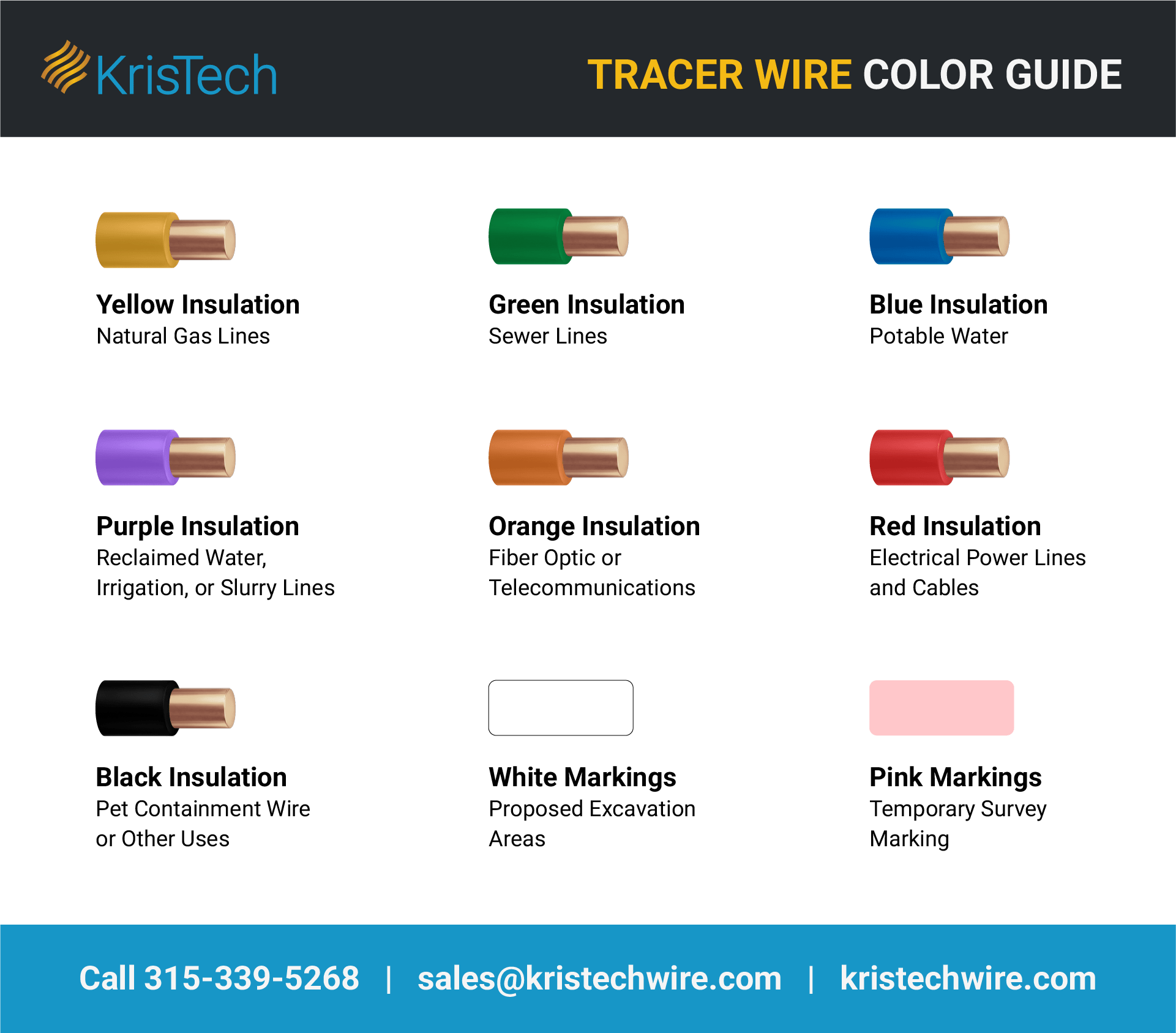
Like the lights on a stoplight, the APWA's Uniform Color Code packs valuable context clues into each color.
The APWA recognizes a rainbow of main colors, though some are admittedly more common than others. What makes the system work well is that each color is specific to a type of utility or asset, making them hard to confuse.
Red - Red tracer wire tracks underground electrical cables, both direct bury and housed within conduit.
Orange - Orange tracer wire helps teams locate buried telecom lines, including phone, fiber optic cable, and standard cable lines.
Yellow - Yellow tracer wire traces natural gas distribution and service lines, but includes oil, petroleum, or other flammable gases.
Green - Green tracer wire helps crews locate buried stormwater drainage lines, wastewater collection, and storm sewers. Keep in mind, this color is used for non-potable (not for drinking) water lines.
Blue - Unlike green, blue tracer wire marks potable (drinkable) water lines.
Purple - Purple tracer wire traces reclaimed water, irrigation, or slurry lines.
Black - Although the APWA doesn’t assign a utility to black tracer wire, it still has a specific purpose. Homeowners can use black tracer wire as part of a pet fence containment system. When animals approach the buried wire, a receiver collar around their neck picks up transmitter signals from the wire.
In special cases, engineers may approve black tracer wire for other non-utility projects.
Other Colors Associated with Tracer Wire
These colors might not be on the wire itself, but they still play a crucial role in maintaining a safe worksite.
White - Though it isn't technically a color used to mark utilities, white is a common color found on work sites. Under the APWA's guidance, homeowners, work crews, and utilities should paint white lines to mark proposed excavation areas. This allows utility crews to immediately recognize where digging may take place and mark hidden utilities nearby. If any lines are within a proposed digging area, crews should use extra caution to avoid damage.
Pink - Similar to white, workers use pink for specific purposes on a job site. In this case, pink serves as a temporary survey marking color. APWA standards denote pink for markings like boundary lines, benchmarking, topography, and other layout notes. Basically, workers use pink marking paint to mark locations they haven’t fully verified yet.
Many Colors, One Purpose
Safety is incredibly important on any worksite but takes additional priority when crews can't see what they're digging into. The APWA color guide is one of several ways to identify underground utilities, alongside analyzing a project’s scope and checking for either metallic or non-metallic tape denoting the color.
Damaging gas lines, water lines, or electrical cables isn't an issue of simply replacing a pipe or cable. In many cases, damaging an underground utility poses an immediate danger or concern to everyone in the area. A damaged gas line could explode, an electrical cable can shock or arc, and broken telecom lines can knock out phone service.
Working safely means knowing the tracer wire colors, accurately locating underground assets, and avoiding potential issues while digging. No matter the project's size, homeowners and work crews should call 8-1-1 before they dig. This free national service sends local utilities to the site to mark or plant flags where underground lines exist. It may take a couple days for every utility to respond, but the wait is well worth the avoided risk.
With a little patience and the right training, it's possible to reduce accidents, damages, costs, and inconveniences.


